Saturday, September 23, 2017

reACT Trainer Total Body Circuit Workout

One of the best tools we have at our disposal at Workout Anytime is the reACT Trainer.  Staff who know how to use the product properly and teach others to use it can make a great impression on any member or guest and help to differentiate their club from competitors.

Although the reACT Trainer is a lower body and core trainer it is easy to create full body circuits using the reACT Trainer along with the key upper body movements including:

Horizontal Press (chest press of some type)

Horizontal Pull (Row of some type)

Overhead Press

Vertical Pull - (some type of vertical pulling movement)

Here is a sample reACT Trainer Total Body Circuit:


Sunday, September 17, 2017

The Role of B-Vitamins in Preventing Brain Loss

One in five people older than 70 suffers from cognitive impairment which will progress to dementia and death in half of these people within five years.  So it is very important to address all the modifiable risk factors for cognitive impairment.   One of these risk factors is elevated homocysteine which is a strong, independent risk factor for Dementia, Alzheimer’s Disease, and Heart Disease.  
One of the longest and most comprehensive studies ever done showed that one in six cases of Alzheimer’s Disease can be caused by increased homocysteine levels.

In order to process homocysteine properly the body needs adequate levels of Folic Acid (Vitamin B-9), vitamin B12, and Vitamin B6.   A double-blind randomized controlled trial showed that the reduction of homocysteine by B Vitamins can slow the rate of accelerated brain atrophy in people with mild cognitive impairment which is often the first step towards Alzheimer’s Disease.
Another study showed that B-Vitamins can reduce brain loss in areas prone to the Alzheimer’s Disease process. 

Other Benefits of B-Vitamins
B-Vitamins as a group are incredible important to a wide range of cellular and metabolic functions from energy production to production of hormones. Benefits of optimal levels include increased energy, improved mood, reduction of allergy symptoms, help preserve vision, help to maintain bone strength, and help prevent heart disease and stroke.

How do I get B-Vitamins?
Although it is possible to get the RDA of B-Vitamins through diet alone it requires a carefully planned diet and for vegetarians it is very challenging because there is no vitamin B-12 in vegetables. Milk, yogurt and cheese, along with eggs, are the only vegetarian food items that naturally contain significant levels of vitamin B12.

In addition many people have conditions which prevent optimal absorption and cellular uptake of certain B-Vitamins such as Folic Acid.   Each of the key B-Vitamins come in several forms with some being much more active and effective than others.   When everything works right the body can convert other forms to the active forms, but there are many things that interfere with this process.

For example Intrinsic factor produced in the stomach is what allows the intestines to absorb this vitamin.  Not everyone produces intrinsic factor so common sources of B-12 are not effective.
Also since B-Vitamins are water-soluble excess amounts are easily and safely excreted so taking a high quality B-Vitamin Supplement or Multiple Vitamin with activated forms of B-Vitamins in adequate amounts is the safest way to cover yourself.    In addition, although each B-Vitamin performs critical functions in isolation they also work together to optimize many functions so taking a complete B-Vitamin Supplement is highly recommended.

What are all the B-Vitamins?

B- Vitamin          Active Form                                                    Inactive Form
B-1                        Benfotiamine                                                Thiamine
B-2                        Riboflavin-5-phophate                                 Flavin Monocleotide
B-3                        Niacinamide                                                 NAD                                        
B-5                        Panthothenic Acid                                         None                   
B-6                        Pyridoxal-5-phospate                                    Pyridoxine Hydrochloride
B-7                        Biotin                                                             None
B-9                        Methyltetrahydrofolate  aka Metafolin         Folic Acid                                         
B-12                      MethylCobalamin                                         Cobalamin

Can you take too much of the B-Vitamins?
For certain ones the answer is yes!  You should not take in more than 800mcg of folic acid supplement.  Too much can mask a condition called pernicious anemia.  Multiple Vitamins and B-Complex Supplements will contain 400 – 800mcg and more from diet is not a problem.

For vitamin B-6 intake above 200mg per day is not recommended.  Again multiple vitamins and B-Complex will generally contain less than this amount and more from food is not an issue.

Regular “Niacin” can cause significant skin flushing and itching, but this is harmless although it can be very uncomfortable.    Extremely high dose niacin can be used to treat high cholesterol levels but the regular form that causes flushing can also cause liver issues at high levels.   This is also true of “time-released” forms.     The best form for use for cholesterol is “Flush Free Niacin” aka Inositol Hexiniacinate as it will not cause these issues.   NAD (Nicotinomide Adenine Nucleotide) is very safe but there is no reason to take more than 10mg per day.

As always do not take any supplement when pregnant without consulting your registered health care professional.


Sunday, September 10, 2017

Foam Rolling aka Self Myo-Fascial Release

Using a tubular foam roller to literally roll over tight areas of muscles and tendons is known as “Myo-Fascial Release”.    While it seems counter-intuitive applying steady pressure to muscles and tendons with an emphasis on trigger points (areas of tightness and soreness) has been proven to be a highly effective method for improving mobility.    

Since you are in complete control of the amount of pressure applied and how long it is applied you can customize the experience based on your level of sensitivity.   Key areas to focus on include the hamstrings, calves, gluteal muscles, latissimus dorsi muscle, and even low back and hip flexors if done with caution.

You can use a tubular foam roller, and they are made in varying levels of firmness from soft to very firm.   In addition, there are variations that include a textured surface of varying levels from small to large finger like projections.  You can also use balls such as a lacrosse ball, baseball, or tennis ball in a similar fashion.     NOTE:  the smaller and firmer the object the more pressure it will tend to apply so proceed cautiously.

The technique is to position the foam roller on the floor (on a firm but not hard surface is best).  Then position the muscle/s you are targeting on top of the foam roller.     For example, for the calf sit on the floor with your target leg extended so that it is on top of the foam roller with the lowest portion of the calf on top of the roller.    

Use your hands to lift your butt slightly off the floor to allow you to apply pressure down onto the foam roller.    Then literally roll forward slowly over the foam roller paying attention to any trigger points where you notice sensitivity or tightness.   

When you find a sensitive area slowly roll back and forth on the spot until you feel it release.   With a little experimentation you will learn how much pressure and speed work best for your physiology. 

Self Myo-Fascial Release/Foam Rolling is a great way to start a workout and does a great job of safely improving mobility before a workout and is also great to do between workouts.

Contraindications to Foam Rolling
Pregnancy – during pregnancy ligaments become lax and pressure anywhere on or near the abdomen is to be avoided at all costs so best to skip foam rolling when pregnant.

Osteoporosis – soft bones and additional pressure are not a good combination so best to avoid foam rolling without a physician’s permission if you have moderate to severe osteoporosis.

Intervertebral Disc Issues – anyone with disc problems in their spine should be cautious with foam rolling because pressure in the wrong areas can create problems so again get guidance from a medical professional if you have an disc issues in your spine.

Inability to support bodyweight on arms or legs – foam rolling cannot be done safely if a person lacks the strength to support their bodyweight on their arms and/or legs.

For a pictorial guide of various foam rolling exercises to target specific body parts click here:   https://www.pinterest.com/explore/foam-rolling/   


Saturday, September 2, 2017

Energy Drinks Pros and Cons

Energy drinks have become a staple for many people, and there is lot of controversy about whether or not they are safe to drink.    Like most things the devil is in the details when it comes to energy drinks.

Sugar Content
One of the first points to consider for energy drinks is their sugar content.  Sugar is something the vast majority of people could do with consuming less not more.  People who drink energy drinks with high levels of sugar are taking in a lot of extra calories - up to 200 calories for large energy drinks with sugar.     This not only contributes to weight gain and slows or prevents weight loss – it can also wreak havoc on the millions of people with outright diabetes and the many millions who are on their way to diabetes due to insulin insensitivity from too much sugar intake and not enough exercise.

Artificial Sweeteners
Although sugar/carb free energy drinks do not have the issues associated with sugar described above – artificial sweeteners are clearly not healthy.     Now like all things it is all about the dosage consumed on a regular basis so someone having a single beverage with artificial sweeteners daily is very different than someone having four!

Caffeine Content
Another important consideration is the “energy” ingredients contained in the drink.     The most common ingredient is caffeine and the typical energy drink contains about 200mg of caffeine or the same amount you get in a large coffee.    If you are an adult and accustomed to caffeine this will provide an energy bump but will not send you into convulsions!    

However, it is all about your size and your experience with caffeine.    The more you take in caffeine the more accustomed you become to it, and larger individuals can safely consume higher quantities for obvious reasons.     Moderate caffeine intake - 300 to 400 milligrams of caffeine per day -- carries "little evidence of health risks and some evidence of health benefits," conclude researchers from the Linus Pauling Institute at Oregon State University in Corvalis, writing in Critical Reviews in Food Science and Nutrition in March 2006.    This equates to 2 average size energy drinks per day.

Other Stimulants
Yohimbine is another potent stimulant so adding this together with caffeine can cause big problems – particularly in those with existing high blood pressure.

N-methyltyramine, Octopamine, and synephrine are other stimulants.     As with Yohimbine best to steer clear of any energy drinks containing any of these ingredients! 

Amino Acids
Most energy drinks include amino acids like L-Phenylalanine and/or L-Tyrosine.   These amino acids act as precursors used by the body to produce excitatory neurotransmitters and hormones.      So they can amplify the effects of caffeine.      NOTE: for people with Phenylketonuria (commonly known as PKU) phenylalanine can be dangerous but there is a mandatory warning on all energy drinks containing this substance.

Another common energy drink ingredient is the amino acid taurine.  Taurine is found in large amounts in the brain, retina, heart, and blood cells called platelets. The best food sources are meat and fish. Excess taurine is excreted by the kidneys.  Taurine promotes cardiovascular health, insulin sensitivity, electrolyte balance, hearing function, and immune modulation.  Authors of a 2012 study actual made the following statement concerning Taurine: “Considering its broad distribution, its many cytoprotective attributes, and its functional significance in cell development, nutrition, and survival, taurine is undoubtedly one of the most essential substances in the body.”    So Taurine is not toxic either.

Another popular ingredient is Glucuronolactone which is added to “aid in detoxification”.  Interestingly enough there actually is some science supporting this claim.    More importantly it does NOT seem to be toxic in moderate doses used in most energy drinks.    Like the amino acids mentioned above glucuronolactone is produced in the body naturally so it is not foreign to cells.  There is an urban legend that this ingredient causes brain tumors but this is just that – a legend!

B-Vitamins
Most energy drinks contain the following B-Vitamins in significant doses:
Niacin – Niacinamide
B-2 - Riboflavin
B-6 – Pyridoxine Hydrochloride
B-12 - Cyanocobalamin
B-5 - Pantothenic Acid

B-Vitamins are water-soluble meaning excess will simply be excreted in the urine, and not having enough B-Vitamins can cause serious issues because B-Vitamins are essential for energy production and many other functions in the body.  

So Why All the Concern?
Like all stimulants – energy drinks can be abused with potentially serious consequences.     Heavy intake (3 or more per day) can cause nervousness and anxiety and heart palpitations.   For those with anxiety disorders, heart disease, or high blood pressure this is a real concern.     Anyone with a heart arrhythmia should check with their physician before taking any type of stimulant including caffeine and energy drinks.

Certain energy drinks like “Redline” which contain multiple stimulants have very specific directions to only consume half a small bottle with a warning that should scare most people.     It is very easy to forget and consume a whole bottle and put yourself in a very uncomfortable and potentially life-threatening situation.   

Always look at serving size, dosage and ingredients and start with smaller intake.    Gradually increase intake.  


Last but not least stimulants can ruin your sleep – so be very careful not to take them past Noon.     Also if you start to develop sleep issues cut back your intake of all stimulants – this almost always helps!     Remember stimulants are not a substitute for rest, sleep, healthy diet, and exercise!

Saturday, August 26, 2017

How to Get Rid of Cellulite

Although the vast majority of woman have some cellulite somewhere on their body – nobody likes it!   So what the heck is cellulite anyway?  Cellulite is pockets of fat that have squeezed between bands of tissue, called septae, that are located below your skin.

Women of all races get it, while virtually no men do. That's because the septae of men are different from women. Men have stronger bands that are cross-hatched allowing them to keep fat in place more effectively. Women have weaker, vertically oriented septae that allows fat to squeeze through easier.

Both thin and heavy women have cellulite. However the higher your level of body fat the more noticeable the dimpling will tend to be.  Unfortunately dieting does necessarily help eliminate cellulite. Losing weight helps sometime, but in some cases weight loss makes cellulite worse.   This occurs when skin becomes saggy after significant weight loss.

There is a definite genetic component to cellulite which does run in families.
Hormones also are part of the equation with cellulite, but science has not figured out exactly how hormones contribute to cellulite.  What is known is that cellulite starts at puberty which is a time that many hormone levels change significantly in females.

Getting Rid of Cellulite

Getting rid of cellulite is easier said than done.  Even treatments like Liposuction are not necessarily effective.    In fact Liposuction often makes cellulite worse by leaving your skin even more puckered looking than it was before.

Dermatologists are quick to point out that there is no magic cure for cellulite, but there are ways to make it look better!   Two of the keys are working out and dropping excess weight sensibly (1lbs per week! – faster weight loss can exacerbate the problem!)

Resistance training is key.   As you increase your muscle size and decrease body fat your skin looks smoother.     If you lose fat while you simultaneously build muscle your cellulite will improve.
It is also important to work on the health of your skin as you age to make it more elastic so that as you lose fat the skin pulls tight rather than sagging.    

Certain topical treatments that increase collagen in the skin, like Retin-A or creams with retinol or vitamin C, cannot hurt and may help.   

Maintaining adequate water intake is also key for skin health and elasticity – 6 – 8 glasses of water per day is key.

If you have faithfully tried everything and your cellulite is driving you crazy and you are prepared to spend some serious dollars – Cellulaze – is an FDA approved therapy.  Cellulaze involves inserting a lazer under the skin and projects heats in three directions and literally liquefies fat as it cuts the septae around fat cells which can reduce the puckering while also encouraging collagen regrowth.

Cellulaze claims a 70 – 80% improvement in cellulite that lasts a full year.  It is most effective for active women with mild to moderate cellulite who are not significantly overweight and who also have good muscle tone.


Unfortunately, Cellulaze is not cheap – costing $5,000 - $7,000 depending on the size of the area being treated.

Sunday, August 20, 2017

How Much Protein Do You Need Each Day?


One of the most controversial and confusing aspects of nutrition is how much protein people should consume each day.    There are several factors to take into account to get a good answer to this question, and there are potential problems with eating too much protein.   There are also definitely problems with not eating enough protein.  It is also important to consider what type of protein is being consumed.

Height, weight, age, sex and activity level all factor into your protein needs.   Obviously the larger you are the more protein you need to take in to support structural proteins throughout the tissues of the body including the muscles, bone, skin and organs.  In the same way the more active you are the more protein you need to consume.  In addition, protein is used to create enzymes, and enzymes are critically important for all cellular function.

Protein is made up of amino acids and there are essential and non-essential amino acids.    Essential amino acids MUST be consumed because they cannot be made by the body.    Complete proteins contain all the amino acids and come from meats, poultry, fish, eggs and dairy.   While vegetarian proteins are not complete it is not hard to combine different plant protein sources to obtain all the protein the body needs to function.

Other factors which influence how much protein is required is overall caloric/energy status.     If you are eating enough calories to maintain bodyweight or gain bodyweight you require less protein as a percentage of overall calorie intake while those people in caloric deficit require a higher percentage of their overall calorie intake to maintain lean tissue mass (losing lean mass like muscle is usually NOT a good idea so this is important).

How much is too much?

In large amounts and for certain populations (such as those with compromised Kidney Function) excess protein can cause problems.    That being said, for the normal healthy individual, the body can easily and safely process and use a lot of protein.    A portion of the protein you eat is frequently converted to glucose (blood sugar) and if your overall calorie intake is too high you will convert excess protein into fat like ALL unused excess calories.

Another potential problem with too much protein is that high protein intake stimulates the release of mTOR which stands for Mammalian Target of Rapamycin.    mTOR is a key regulatory protein that signals for cell growth through the creation of new proteins. Consider protein building similar to a race car. The larger the engine, the greater potential for speed. Similarly, the more mTOR present in any given cell, the greater potential for more protein construction. And just like the gas pedal fuels the engine, mTOR is a signaling protein, and can be various levels of active (like a pedal’s ability to regulate speed). If a number of different processes all signal for ‘Go’, then the cell builds as much protein as it can, as quickly as it can. So just as a souped-up car takes off rapidly, a muscle cell can signal for tremendous muscle growth very quickly, given the right conditions.   n

For this reason, mTOR is a good thing when you are looking for muscle-building!  However, there is a potential dark-side to mTOR.   Cancerous tumors are designed to grow as fast as possible, and they rely on mTOR signaling to build proteins just like healthy cells.   So too much mTOR could theoretically put people at a higher risk of developing rapid and serious cancers.  In fact, a lot of cancer research is based around slowing down and minimizing mTOR activity in tumor cells (the exact opposite goal of muscle research).
 
This doesn’t necessarily mean that eating more protein for muscle building is going to cause cancer. Numerous other proteins and factors come into play, and some may respond differently in muscle cells than in cancerous cells.

Safe and Adequate Protein Intake

The Institute of Medicine's protein RDAs are calculated using 0.8 grams of protein per kilogram of body weight. This means an adult who weighs 68 kilograms needs at least 54 grams of protein each day. The RDA for pregnant and nursing women is 71 grams of protein per day.  Keep in mind the RDA is a MINIMUM and does not mean this is ideal!   This also assumes you are sedentary!   So, if you are exercising and trying to build muscle or older and trying to prevent muscle loss higher protein intake is better.  To determine your minimum daily intake, divide your body weight by 2.2 to determine your weight in Kilograms and then multiply by .8 to get your minimum daily protein intake.  

The Academy of Nutrition and Dietetics states that although athletes only need about 1 gram of protein per kilogram of bodyweight to maintain muscle mass, they require 1.4 to 1.8 grams of protein per kilogram to build muscle mass; this is equivalent to about 0.64 to 0.82 grams of protein per pound of body weight each day.


Sunday, August 13, 2017

Workout Anytime Daily 10 Prehab Routine

Everyone knows that prevention is better than dealing with an injury, and part of injury prevention is spending time working on what are commonly referred to as “corrective exercises” or “Prehab”.   10 minutes a day spent doing 10 basic exercises can prevent many injuries, improve results from exercise, and dramatically improve movement.

Ideally do these exercises barefoot or in socks – your feet will be working very hard during these exercises and shoes reduce ground feel.  If possible do them in front of a mirror to see your form!

Hip Hinge – Hip Hinging is one of basic primal movement patterns, and it is also the movement pattern most frequently done incorrectly.   The best way to groove this movement pattern is practice it using a wooden handle or PVC Pipe held vertically against your back touching the back of your head, the top of your shoulders, and your tail bone.  By keeping contact with all three points as you hinge it teaches you to maintain a flat back which is essential for preventing low back injuries and developing proper movement mechanics that allow you to effectively load and unload the glutes and hamstrings.

It is also a phenomenal dynamic warm-up for the hamstrings!   Here is a video showing how to do it:  https://www.youtube.com/watch?v=PG67O49Hsso    Do 50 reps per day and you will see and feel positive changes in your posture, movement, strength and mobility!

Downhill Skier Exercise – This exercise contains elements of the squat and hip hinge.  Start by placing the hands palm down on the top of the thighs.  Keep the back straight slide the hands down until the palms are resting on the knees with the hips back like you are a second basemen.   You should begin to feel a stretch in the hamstrings.     Continue to hinge from the hip forward and slide down until your elbow are resting on the inside of the knees with back straight and hips back like you are a downhill skier.  This will require your knees to track forward over and maybe even slightly beyond your toes (this will generate a stretch in the calf muscles and specifically the single joint soleus muscle).    Keep your heels down the whole time – do not let them lift up off the floor!
Keeping the back totally straight extend the knees as far as possible – you should feel a strong stretch in the hamstrings.  Your hips will rise but keep your elbows on the knees and do not move the upper body!  Then drop the hips, flex the knees and let them move forward over toes as you drop back down to the downhill skier posture.

Start slow but as you get the hang of it you can move faster – as long as you maintain proper form.     Do 30 – 50 reps every day.   You will start to notice that your squat and your hip hinge movements all get easier along with improved mobility in the ankle knee and hip!   Click here for a great video of how to do this exercise properly:  https://youtu.be/nXKWtlr3rBQ

Goblet Squat – Squats are another primal movement pattern and goblet squats help emphasize the best form.   They should be done daily with a relatively light weight for a good 20 – 50 repetitions.    Keep the dumbbell, kettlebell or Sandbag held against the chest the entire time. If you have difficulty getting thighs parallel to the floor spread your feet farther apart, and also rotate out at the hips so that your feet are pointing outwards.   This can make a huge difference.   By doing this and holding a light weight against your chest you may find you can squat to a decent depth while maintaining an upright torso.  It should look like this:  http://cfitness.me.formecdn.com/2016/12/goblet-squat.jpg  

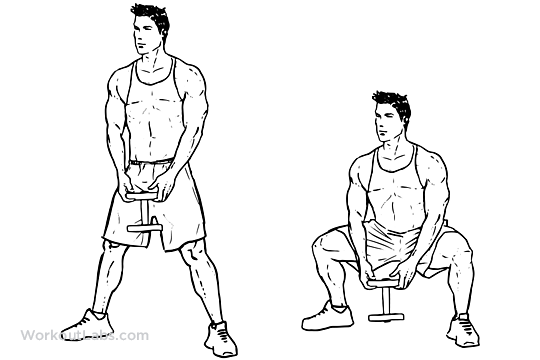
Alternatively you can hold a kettlebell/Dumbbell with both hands letting it go straight down between the legs as you squat down like this:  http://workoutlabs.com/wp-content/uploads/watermarked/Pile_Sumo_Dumbbell_Squat1.png

Single Leg RDL – Romanian Deadlift – is one of the most important corrective exercises you can do to help self-identify and correct muscle imbalances that are the most common cause of movement dysfunction and injury.

The best way to do this exercise is barefoot in front of a mirror where you can see your whole body throughout the entire sequence of the exercise.  Ideally you should be on a firm and level surface as well.

Start by facing the mirror standing on one foot with the other leg flexed so your thigh is parallel with the floor and knee flexed to 90 degrees with hands on your hips.  Look in the mirror and make sure your hips are perfectly level and if not fix that!   

Next, without moving the upper body extend the flexed leg down and hinge forward at the hip of the standing leg.   As your swing leg passes the other leg you should try to straighten it, and ideally you hinge forward at the upper body while keeping your swing leg and upper body in a straight line the whole time.

As you hinge try NOT to let your swing leg hip drop and keep your stance foot pointing directly forward with no angle.  The stance leg should flex slightly but the knee should NOT move forward – rather you should “sit” back into the hinge at the hip. Pause when you reach at or near parallel with the floor with your upper body and swing leg then smoothly return to standing and flex the swing leg.    Slower is harder AND better and do NOT use any load/weight.

10 repetitions on each side each day!   Do all 10 on each side one time per day and you will see some amazing changes in your strength, balance and athleticism! 

Here is a great single leg RDL tutorial:  https://www.youtube.com/watch?v=vc21IwnIcwk

Hip Thrusts – The hip thrust simultaneously develops the glutes while enhancing mobility in the hip flexors (both key because this counteracts the negative effects of sitting all the time!).  These can be done on the floor or with shoulders on a bench, bed or sofa to make it a bit harder.   You can do hip thrusts with two legs or one leg at a time to create additional load.   Here is a good shot of the exercise:  http://cdn-www.womenshealthsa.co.za/wp-content/uploads/2015/02/hip-thrust-hold.jpg

Important NOT to arch lower back at all and concentrate on squeezing glutes at top and NOT using low back.    Even without any load this exercise can produce great benefits – 20 – 50 reps each day!

Plank – The plank is a simple functional core exercise that produces great benefits.  It can be done on toes and hands (upper push-up position), Toes and Elbows, Hands and Knees, etc to adjust the difficulty.    Do a version of the plank that challenges for one minute per day while maintaining good form.   Here is a great article on some of the many variations:  http://www.health.com/health/gallery/0,,20813896,00.html/view-all

Side Plank – The Side Plank is also key to building core strength, but in the front plane (side to side stability and strength).   30 seconds to a minute on each side each day.   Like the plank there are many variations and one of the best when you are ready is a side plank with leg lift: https://rutheburke.files.wordpress.com/2015/05/side_bridge_abd.jpg

Static Lunge – Lunges are another primal movement pattern, and there are many different variety of lunges.  A static lunge is done with feet in a split stance like this:    https://www.google.com/imgres?imgrefurl=http://thefitnesslink.uk/exercises/static-lunge/&tbnid=J1sOV9EYH0PmVM:&docid=lgeVWz3ThLe7OM&h=1417&w=1890   

The exercise is fantastic for simultaneously developing strength and mobility in the foot, ankle, knee and hip.  Best done barefoot on a firm surface.  Keep your front heel down the entire time and rear foot is up on ball of the foot with rear knee, hip, back and head kept in alignment the entire time.    Do 10 reps at a time on each side per day – no weight is necessary. 
 
Side to Side Skater – This exercise develops hip mobility including providing an excellent dynamic stretch/warm-up for the adductor (inner thigh muscles).  Feet should be wide apart with feet facing forward – not angled out. Keep feet flat on the floor and flex forward at the hip keeping back straight (only flex forward as far as you can while maintaining a flat back and keeping both feet on the floor with entire foot kept down in contact with the ground).   Push the hips directly to the side and pause as you feel a stretch in the trailing leg’s adductors.  

Ideally your head and torso stay perpendicular to lower body and centered during the entire exercise just like a speed skater.  Then push your hips back in the other direction to the other to the other side.    NOTE:   Do NOT go up and down – your hips should go back and forth in a straight-line parallel with the floor.   Do 20 – 30 reps each day.

Ankle Circles – This exercise improves ankle mobility and is great before just about any activity.    Stand on one foot.    These can be done seated, standing or lying down – best done standing to simultaneously work on balance and stability.  The action is simple:  holding foot and leg in the air draw a circle with your toes for 10 circles in one direction and 10 circles in the other direction like this:  http://web.eccrsd.us/christy/public/athletic_training/ankle_sprain_rehab_beginner_files/Picture%201.jpg   

You will notice that one direction is much harder than the other and you will feel much less coordinated and same thing with one leg vs the other leg.  Do more repetitions in the direction that is challenging and more on the leg that is more challenging.  Ideally do the exercise while you stand on one foot while you pull your other leg up with knee bent so that your thigh is parallel with the floor.    This is more challenging than it looks but will provide big benefits in terms of balance and stability.


Done daily and before workouts these 10 exercises will provide big benefits including improved posture, stability, strength and mobility.   You will also notice that you improve at many other exercises and movements.

Sunday, August 6, 2017

Arugula - Not Just Good for Salad!

Arugula is known for as being a tangy salad green, but it is also a relative of the cruciferous family, which includes radishes, Brussels sprouts, kale, cauliflower and broccoli.   Like these foods, arugula has many highly beneficial nutrients that include anti-cancer compounds and carotenoid anti-oxidants that help eyesight.

These beneficial plant chemicals include flavonoids that improve blood vessel function, increase blood flow, lower blood pressure and lower inflammation. Arugula can also help to counteract the negative effects of heavy metals and helps eliminate pesticides from the body.

Research shows that the trace minerals and antioxidants arugula contains can block the absorption of environmental contaminants suspected of impacting your libido.

Arugula and Nitric Oxide

Arugula contains the highest levels of nitrates of any plant, and nitrates are used to produce nitric oxide (NO) in the body.    NO is a very important signaling molecule that supports healthy endothelial (blood vessal lining) function and protects the mitochondria of the cells. 
  
Arugula contains about 480 milligrams (mg) of nitrates per 100-gram serving compared to 281mg for rhubarb, cilantro at 247, and 110mg for beets.  Spinach also contains high levels as do all green leafy vegetables which is thought to be why their consumption helps prevent heart attacks, stroke and heart disease.

High Nitrate intake boosts NO directly.   NO relaxes and widens blood vessels dramatically increasing blood flow and oxygenation of your tissues.  This increases the body’s ability to carry away waste material and carbon dioxide.  A diet high in nitrates can help prevent and treat high blood pressure in this manner.

Although raw beets are the best-known vegetable for boosting NO, increasing circulation and lowering blood pressure arugula is the real king.

Nitrates, NO and Exercise Capacity and Endurance


Nitrate intake and increased NO in the body has been proven to dramatically increase exercise capacity and endurance, and the drug Viagra functions by boosting NO levels which is the drug treatment for male impotence.  So a healthier heart, lower blood pressure and increased exercise capacity are not the only reasons to increase your intake of Arugula!

Sunday, July 30, 2017

How to Optimize the Benefits of Vitamin D Supplementation

Vitamin D is constantly in the news lately and for good reason.    Optimal levels of Vitamin D have been linked to a host of benefits including prevention and treatment of many key diseases ranging from Osteoporosis to improved heart health with reduction in heart attack risk to prevention of many different types of cancer.

The ideal way to get optimal levels of Vitamin D is to let your body create it through Safe Sun Exposure (see previous blog on this subject here:  http://workoutanytime.blogspot.com/2016/08/the-facts-on-safe-sun-exposure-and.html  However this is easier said then done, and too much sun is clearly a strong risk factor for skin cancer!      Enter Vitamin D supplementation.

The amount and form of Vitamin D supplementation has changed substantially based on lots of emerging research.    The form that should be taken is Vitamin D-3 NOT D-2 form and all experts agree on this!     However when it comes to dosage things get much trickier.      The confusion comes because Vitamin D is really a powerful compound and functions as a hormone in the body.    As such it has profound impact on virtually every system in the body.    In addition you can overdose on Vitamin D supplements so more is NOT always better!

Ideally you should order a blood test and test your levels.    The test you want is called a 25(OH)D blood test and is offered by all major labs.   You can either ask your doctor to order this test for you OR you can order an in-home test.   You just prick your finger and put a drop of bloo on the enclosed paper and send back in to the labs.    You can also your own blood test online and go to a lab to have blood drawn in the same way your doctor orders the test.   For more information on testing go here:  https://www.vitamindcouncil.org/testkit/?gclid=Cj0KCQjwh_bLBRDeARIsAH4ZYEPhv0MVkO5_S7USZZ8bwVlt5A3vPWGbBFFIbJiB8Wtva0x-IDH7UmQaAlGkEALw_wcB#

Ideal versus Acceptable Blood Levels of Vitamin D

There is a big difference between what is considered “acceptable” or okay and ideal blood levels.   Here are the classifications of different blood levels of Vitamin D. according to the Vitamin D Council:
0 – 30 ng/ML is very low and considered a deficiency
30 – 39 ng/ML is better but still insufficient for optimal health and disease prevention.
40 – 100 ng/ML is optimal
Above 150 ng/ML is toxic!

The key is to test and if low take a supplement then retest 2 – 3 months after regular vitamin d use because each person is different in how much supplementation they need based on many factors including sun exposure and skin type.     The RDA for Vitamin D for infants is 400iu.    For Children 1 – 13 and adults through age 70 the RDA is 600iu and for those over 70 the RDA is 800iu.

Unfortunately, this is way too low to get many people into the sufficient much less optimal range so testing is really worthwhile.   In many cases people need 4,000 – 10,000 or more iu's per day for at least a month to get where they need to be for optimal health!

Preventing Vitamin D Toxicity through the Co-Administration of Vitamin K-2

Like many vitamins Vitamin D has a co-factor or other vitamin that helps it perform its function better and in a more balanced fashion, and that other vitamin is Vitamin K-2 (not to be confused with K-1 found in many plants).    In an ideal world, you can get all the Vitamin K-1 you need from eating plenty of green, leafy vegetables, and your body can turn it into K-2.   Unfortunately, this conversion is lacking in many people.

More importantly K-2 is not easily toxic and can be taken with Vitamin D.    K-2 is best taken as a supplement as MK-7 version which has been heavily researched and shown to improve bone health and prevent arterial calcification which can potentially occur with too much Vitamin D.     For a more complete understanding behind how K-2 works with Vitamin D and why it is a great idea to take the MK-7 form of K-2 with Vitamin D check out this article from Dr. Mercola:   http://articles.mercola.com/sites/articles/archive/2011/03/26/the-delicate-dance-between-vitamins-d-and-k.aspx


Taking 100 – 200 mcg per day of Vitamin K-2 will help optimize the effects of Vitamin D and minimize risks associated with Vitamin D Supplementation.

Monday, July 24, 2017

The Nordic Hamstring Curl: Best Hamstring Exercise You are Not Doing!

There are many different hamstring exercises including variations of leg curls (seated, prone, and standing) along with several different hip hinge exercises that target the hamstrings (RDL, Single Leg RDL, etc).     These are all great exercises, but none of them can touch the Nordic Hamstring Curl for building eccentric strength and preventing hamstring injury in sprints and sport!

This is a tough exercise so warming up the hamstrings is essential.  Using other hamstring exercises first such as bodyweight hip hinges and light leg curls on a machine prior to this exercise do the trick nicely.   It is also a good idea to do some static stretches for anterior hips and hip flexors to shut them off which helps to allow for maximum hamstring activation.

To perform the Nordic Hamstring Curl you need to find a place to hook your heels under when you are in a double leg tall kneeling position so you will also need padding under your knees.     If you have a workout partner you can have them kneel behind you and hold onto both your legs right above the ankles keeping their arm straight so they can use their bodyweight to apply load as you let your body fall forward like this:   http://willlevy.com/wp-content/uploads/2014/08/Nordic-Curl.jpg .     You can also find something to hook your ankles under like the horizontal bar from a weight machine or barbell like this:   https://i.ytimg.com/vi/f_GdZKdwovA/maxresdefault.jpg  or  this:   https://s-media-cache-ak0.pinimg.com/originals/29/04/34/290434956cdd220cc8d6e0b18948cf3c.jpg or this:  https://www.t-nation.com/img/photos/2013/13-775-04/Nordic-Start.jpg

Keeping your hips flat (straight line from knees through hips and shoulders) – you lower your body down slowly until you can no longer hold your weight then catch yourself in push-up position and push back up:  https://simplifaster.com/articles/wp-content/uploads/sites/5/2017/03/GHR.jpg .       You can also use a band during the exercise which provides progressively more assistance as you go lower towards floor to allow you to potentially perform the full range of the motion and come back up with the assistance of the band.    Then over time you gradually decrease the assistance of the band by user smaller and lighter bands.      This provides a good video of how you can do this by attaching a band overhead and behind you:  https://www.youtube.com/watch?v=LQm9rdzZlRk

There are also numerous machines designed for this exercise including:

Here is a 6 week progression:

Week                   Sessions/Week                  Sets                       Reps                     Rest
1                                           1                            2                            5                            2 min.
2                                           2                            3                            5                            2 min.
3                                           2                            3                            6                            2 min.
4                                           2                            3                            7                            2 min.
5                                           3                            3                            8                            2 min.
6                                           2                            3                            9                            2 min.