It's fall allergy season again and this can mean dealing with pretty severe symptoms in sufferers. Treating allergies with nutrition and nutrition supplements can have big advantages over using medications.
Cable Pull-Throughs may be the best exercise you aren’t doing! They share a lot in common with the Kettlebell Swing, but they are much easier to learn and can really help to groove the hip hinge pattern. The pull-through is fantastic for building posterior chain strength and directly carries over to the field of play by teaching you how to use your glutes and hamstrings to produce hip extension for running and jumping.
Specifically, it teaches you to separate your low back from your hips during the hip hinge pattern. Many people use their low back to produce movement which sets them up for injury! The pull-through also provides full-range loading with no dead spots in the movement which teaches you to maintain full-body tension throughout the entire range of motion for hip extension and flexion.
You heard that right - not getting enough quality sleep is directly linked to craving sweets, weight gain, and difficulty losing weight!
Sleep: Your Body’s Best Friend
Sleep is important for just about all the systems in your body, and lack of sleep reduces cognitive function including reduced reaction time, impaired decision making and memory. Sleep is also essential for the repair and recovery of the body.
Even if you think you get enough shut eye you may still be suffering from the symptoms of sleep deprivation. Unfortunately, just a little sleep deprivation can have a significant effect on weight gain.
How Lack of Sleep Causes Weight Gain
Lack of sleep increases the levels of a stress hormone called cortisol, and cortisol increases appetite significantly. Sleep deprivation also saps willpower and decision-making ability so not only are you hungrier – you are more likely to make poor food choices. Sleep deprivation is a stressor and when you feel stressed you tend to choose high carb foods which boost serotonin.
At the same time, the body’s ability to handle carbs properly is reduced. Your cells become less sensitive to the effects of insulin called insulin insensitivity which is what type 2 diabetes is all about. If lack of sleep is a chronic condition you quite literally can make yourself gain weight and become diabetic!
In addition, when you are tired, a hormone called Ghrelin is boosted while Leptin levels drop. This is quite literally a double whammy because Ghrelin increases hungers and Leptin tells you when you full and satisfied. So you are hungrier but do not feel satisfied when you do eat so you eat more!
In fact, studies have shown increased calorie intake of over 300 extra calories per day in sleep-deprived people.
Sleep is as important as exercise and diet so make it a priority and check out this previous blogpost on how to improve sleep:
Tempo is the speed of movement for a resistance training exercise and there are four distinct phases for each exercise. Tempo directly determines time under tension which is a very important variable in resistance training.
Many people notice that eating breakfast makes them hungrier throughout the day, and this is probably NOT their imagination! In this case the culprit is likely what they eat. Specifically, refined carbohydrates, including sugar, can drive hunger particularly if they are consumed with little fat or protein.
Many people know that the mid-day sun exposure stimulates Vitamin D production which is critical for overall health and wellness. However, most people are not aware that the other portions of the sun’s energy spectrum are also critical for robust health and wellness!
There are
four key practices to harness the tremendous benefits of the sun:
Go outside as
soon as possible after waking up to expose your eyes to the high levels of blue
light from the sun.
Get adequate
Mid-Day Sun exposure on as much skin as possible to optimize Vitamin D
production.
Get adequate
morning and late afternoon sun exposure to expose your body, eyes and brain to
the highest levels of Near Infrared Rays from the Sun.
Minimize
light exposure and particularly blue light exposure in the evening
Waking
Sun Exposure and Circadian Rhythm and Sleep Quality
Many people
are aware that evening and night light exposure can really hurt your sleep. However, what most
people do not know is that early morning sunlight/blue light exposure is just
as important to setting your body’s circadian rhythm and getting a good night’s
sleep!
Human beings
have been on the earth for hundreds of thousands of years and until very
recently we got early morning sun exposure every single day as soon as we woke
up. The sun emits high quantities of
blue light.
The key to
setting our daily rhythm is high levels of bright blue light in the morning and
low to no levels of blue light in the evening and before bed!
Indoor
lights do not pack nearly the punch of outdoor sunlight – even on an overcast
day. Brightness levels are measured in
“lux”, and on a bright sunny day the outdoor lux levels are over 100,000
lux! You may also see the term “lumens”,
and 1 lux = 1 lumen per square meter so they can be used somewhat interchangeably.
Even on a very overcast day outdoor
light levels are close to 2,000 lux. In contrast - the average well-lit home indoor lux levels are somewhere between 100 – 500 lux
so MUCH lower than outdoor sunlight!
Even 5 minutes of exposure to morning sunlight on a bright day is sufficient to help your sleep and energize you in the morning! On overcast days try to get 10 – 15 minutes of outdoor light – you can have your coffee outside!
During winter months it is
well worth considering purchasing a high lux light – needs to be at least
10,000 lux to be effective and there should be zero UV light emitted. Here is an excellent unit: https://www.amazon.com/Carex-Day-Light-Classic-Bright-Therapy/dp/B00PCN4UVU/ref=psdc_13053141_t4_B078KFCN1N
Sunlight
and Vitamin D
Vitamin D is
produced by the UVB rays emitted by the Sun and these levels are highest during
mid-day sun and depending on your skin type, time of year and where you live you
need to spend anywhere from 5 – 30 minutes with plenty of your skin exposed to
achieve the Vitamin D boosting effects.
To learn more about this check out this previous blog post on safe and
effective sun exposure: http://workoutanytime.blogspot.com/2022/05/the-facts-on-safe-sun-exposure-and.html
Morning
and Late Afternoon Sun Exposure
Another
important portion of the Sun’s Spectrum is infrared and near infrared light
(NIR) which we experience as heat. In particular near infrared light has been
proven to provide tremendous health boosting effects. Fortunately – the near infrared portion of
the sun’s rays makes up 40% of the output and near infrared is highest in the
morning and late afternoon.
Whenever you
feel heat from the sun you know you are getting infrared and near infrared
exposure and unlike UV light near infrared cannot damage skin and goes through single
layers of clothing easily. In fact, near infrared can actually penetrate
through the skull into the upper meninges of the brain with some big benefits!
Benefits
of Near Infrared Exposure
There are big
benefits to Near Infrared because NIR directly stimulates increased energy production
from the mitochondria in our cells which are responsible for almost all the
energy in our bodies.
As the
mitochondria increase energy output they also generate melatonin! Melatonin is not just important for stimulating
our sleep cycle – it has many other powerful benefits.
Melatonin has been shown to have
antioxidant and anticancer effects, to play a role in the regulation of blood
pressure and glucose levels, is highly anti-inflammatory, and has also been
shown to lower the risk of SARS-CoV-2 infection and mortality.
Melatonin exists in two main forms within the body – circulatory melatonin, which is produced by the pineal gland and has its major effect on sleep and the circadian rhythm, and subcellular melatonin, which is produced and used locally by the mitochondria within our cells.
Sunshine is our major source of infrared and NIR light, but it can also come from exposure to fire (campfire, candle flames, fireplace, etc.) and certain types of light bulbs. Here is a great video showing exactly how this production of melatonin produces its many benefits: https://youtu.be/sNklS0lzlgA
Near Infrared Maximized by Plants
While direct sunlight exposure is
great – you can actually magnify near infrared exposure by walking in and
around plants! Green leaves strongly
reflect NIR – checkout this NIR camera photo to appreciate just how much NIR
plants can give off: http://www.idahoairships.com/idaho-airships-envira-nir-gallery-working-2_19-31/
NIR in Winter
To get the benefits of NIR during
winter months you can use a infrared/near infrared sauna or use a high quality
Near Infrared Bulb. Here is an excellent
example: https://www.amazon.com/TheraBulb-NIR-Near-Infrared-Bulb/dp/B01855YCXM
Minimizing Blue Light Exposure at Night
During the evening and night-time
hours it is critical to reduce overall light exposure and specifically blue
light exposure to allow the Pineal Gland to release melatonin.
Here are some key steps you can take to minimize blue light at night:
Reduce the light levels in your home by
using dimmers or just turning off lights.
Minimize your exposure to TV – particularly in the hour before going to sleep.
Minimize use of your phone and computer
Install a redlight filter like the free Twilight App for your phone and the free flux program on your laptop to reduce blue light output based on time of day so that during evening and night hours you get less blue light exposure!
Replace regular night lights and bedroom bulbs with redlight bulbs – true redlight does NOT interfere with sleep or melatonin release they way Blue Light does. In addition, it does not interrupt night vision. Here is a great product that you can also travel with: https://shoptruelight.com/product/truelight-luna-red-portable-nightlight/
You can also try blue light blocking glasses which are available on Amazon.
Keep your room as dark as possible when sleeping and/or consider buying a comfortable pair of sleeping mask which blocks all light.
Take Home Message
Sun exposure is part of our evolutionary
heritage and you NEED regular sunlight optimize your health and wellness. To see an excellent in depth review of
the research on the concepts mentioned in this blogpost click here: https://youtu.be/5YV_iKnzDRg
Yes – you heard that right – the Flamingo Test – or one legged stance test is directly correlated with your risk of dying as you age! Balance is a strong indicator of your overall health, and as you age keeps you from falling which can cause serious injuries and death.
Falls are
the second leading cause of unintentional injury deaths world-wide with an
estimated 684,000 people dying from falls each year!
In a new
study published in the British Journal of Sports Medicine researchers tested people
between the age of 51 – 75 asking them to balance on one leg with their heads
up and their arms at their sides for 10 seconds.
20% of them
failed. When the scientists followed up
seven years later, those who failed the test were 84% more likely to have died
than those who passed.
When you consider
that you spend the vast majority of your time on one foot during all movement
you can begin to see why the ability to maintain balance while on one foot is
so important.
Simple
Exercises to Improve Balance and Decrease Fall Risk
Do single
leg balance exercises daily – and do them near a solid base of support you can hold
onto if you feel like you are going to fall.
Over time you will improve your ability to balance on one leg, and you
can continue to improve balance by increasing the level of challenge once it
gets easy. You can do this in several
ways:
1. Try closing your eyes – be careful
this is really challenging but if you build up to the point where you can stand
on one leg with closed eyes you will have dramatically improved your balance
and ability to prevent falls.
2. Build your lower body strength and
core strength through strength training exercises.
3. Use the reACT Trainer – there is no
better way to build lower body and core strength and stability resulting in
dramatic improvements in balance. To learn how to use the reACT Trainer click
here: https://www.youtube.com/playlist?list=PLuwTn-fHAYmTlZ64o-wcMPYaWawTfKZnl
4. Make sure you get your vision checked
and corrected – vision problems account for many falls!
Anxiety is something we all experience at some time or another, but for many it is a constant challenge. It is estimated that 30% of adults suffer with anxiety and many children as well. At its worst anxiety can be crippling and even when it is not that severe it is extremely unpleasant.
Regular
exercise has been proven to be incredibly effective at quickly reducing anxiety
and keeping it under control. However exercising is not always practical when you are in the middle of a panic attack or experiencing high
anxiety.
In this case
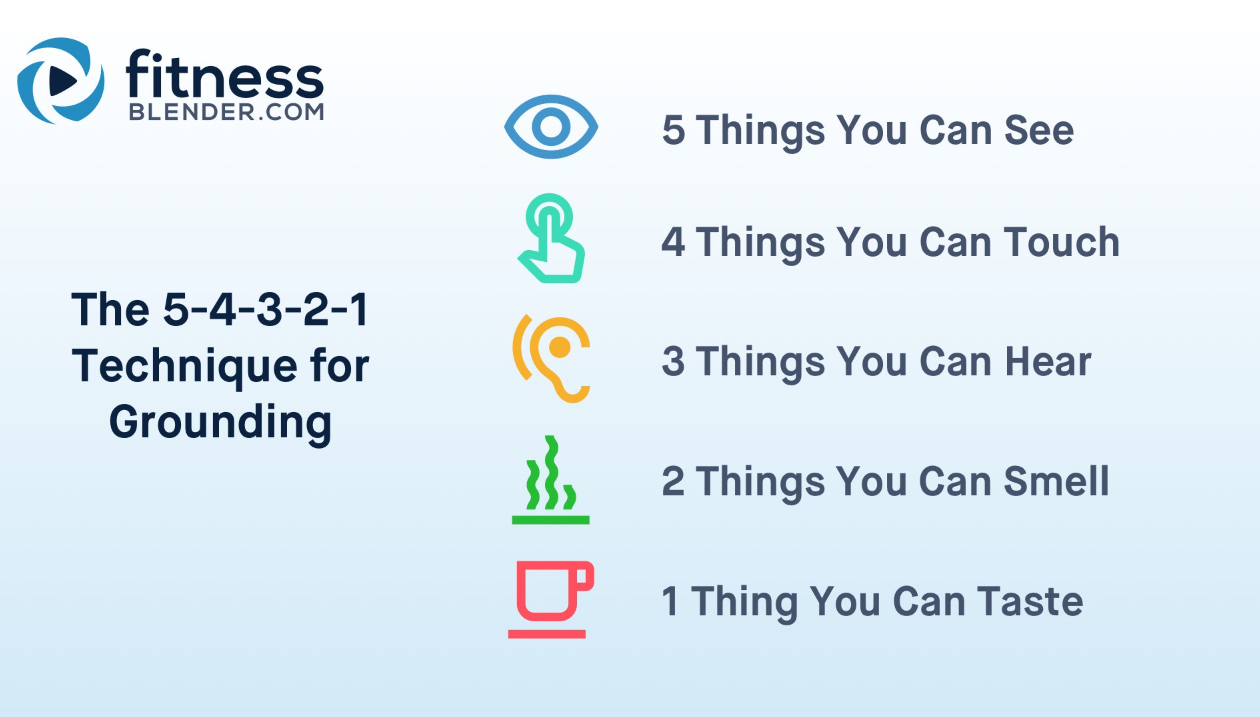
the 5-4-3-2-1 technique is a simple method to quickly reduce anxiety that can
be done by anyone, anywhere, anytime. The
reason it works is because it addresses the root cause of ALL anxiety which is
fear and uncertainty about the future.
Anxiety is always about what is going to happen – not what is happening
right now! Some anxiety is about what
is going to happen in the near future – such as when you are about to give a
speech and other anxiety is about events further ahead.
In any case if
we can shift our mindset to be fully in the present moment anxiety disappears! The 5-4-3-2-1 technique is a great way to
do this, and here is how you do it:
1. Start by simply paying attention to
your breathing – just pay attention – do not try to change your breathing - just observe it!
2. Next identify 5 things you see around
you such as a spot on a wall – a painting – a glass on a table – you can say it
out aloud or just to yourself.
3. Next identify 4 things you can feel/touch
around you. Could be a wall, a door,
your hair, the ground, etc.
4. Next identify 3 things you hear. This could be external like an air
conditioner or internal like your belly rumbling.
5. Next identify two things you can
smell – you can move around to find some type of odor if you cannot immediately
smell something.
6. Next identify something you can taste
– like gum, your toothpaste from when you brushed your teeth, or the meal you
had before.
Do not worry
if you cannot identify every item – the key is shifting your mental focus to
your immediate surroundings and connecting with all five senses: sight, sound, touch, taste, and smell.
You will be
amazed how quickly this can reduce anxiety and bring you into the present
moment where anxiety does not exist!
For more information on this technique click here: https://www.fitnessblender.com/articles/the-5-4-3-2-1-grounding-technique
You heard that right! Recent research is overriding long standing exercise recommendations to optimize lifespan and prevent death. Many are familiar with existing American Health Association Guidelines stating that you need to do 150 minutes of moderate exercise or 75 minutes of intense exercise per week to get the most benefits from exercise.
A new
National Institutes of Health – funded, peer-reviewed published study look the self-reported
activity of 100,000 adults over 30 years.
They found
that those who exercised two to four times the 150-minute moderate exercise per
week recommendation had a mortality reduction of 26% to 31% respectively.
Those who
exercised two – four times the 75-minute intense exercise per week
recommendation had a mortality reduction of 21% - 31% respectively.
Those who
hit the current recommendation of 150 minutes of moderate exercise per week still
saw a 20% mortality reduction.
Those who
hit the current recommendation of 75 minutes per week of intense exercise per
week had a 19% reduction in mortality risk.
The
study concluded that the maximum benefit in mortality reduction occurs when
doing between 150 – 300 minutes of intense exercise per week or between 300 –
600 minutes of moderate activity OR both!
Critically
the study did NOT find any link to adverse cardiovascular health effects for
those people who exercise more than four times the current recommendations for
moderate and vigorous activity.
What does
Moderate and Intense Exercise Mean?
Heart Rate –
if you use a heart rate monitor moderate exercise can be defined as exercising
between 50% - 70% of your Maximum Heart Rate for Moderate Exercise
Intensity. 70% - 85% of your Maximum
Heart Rate for Intense Exercise. To
determine your maximum heart rate and heart rate zones review this previous
blogpost: http://workoutanytime.blogspot.com/2022/04/the-incredible-benefits-of-walking-and.html
Rate of Perceived
Exertion for Moderate Exercise (how hard does it feel?)
1. Your breathing accelerates but you are
NOT out of Breath if not talking continuously.
2. You start to sweat lightly after 10
minutes
3. You can talk but NOT sing
Rate of Perceived
Exertion for Intense Exercise (how hard does it feel?”)
1. Your breathing is deep and rapid and
hard to keep mouth closed and not breath through mouth.
2. You develop a sweat after only a few
minutes
3. Hard to speak – cannot say more than
a few words without pausing to breath.
Watermelon does not just taste great – it is great for you! It is a cousin of cucumbers, pumpkins, and squash.
One of the reasons watermelon is beneficial is that it contains a high quantity of lycopene which is a powerful plant chemical that gives watermelon its red color like tomatoes (another source of lycopene). Lycopene is a potent antioxidant, and watermelon contains 1.5 times more lycopene than tomato which is the more commonly known source of lycopene.
Lycopene is a carotenoid, similar in structure to beta-carotene associated with carrots. However, lycopene is much more potent than beta-carotene and provides many unique benefits. In one study, men with the highest plasma levels of lycopene were 55 percent less likely to have a stroke than those with the lowest levels.
Lycopene Fights Cancer
Scientists at eh University of Portsmouth showed that lycopene slows the growth of breast and prostate cancer by interfering with signaling pathways that facilitate tumor growth. Lycopene also slows the growth of renal cell cancer and helps prevent the cancer from occurring in the first place. Lycopene has also been shown to work to combat the negative effects of HPV infection (Human Papilloma Virus) which is the cause of cervical cancers, uterine cancer, and certain throat cancers. It helps the body combat this virus.
Lycopene and Eye Health
Lycopene
protects eyes from oxidative stress that causes many eye diseases and is one of
the strongest eye nutrients you can consume. It may even have the capacity to delay or even prevent cataracts. Through its antioxidant and anti-inflammatory
effects, lycopene can help slow or stop processes that lead to macular
degeneration.
Lycopene Reduces Neuropathic Pain
Neuropathic
pain is pain from nerve damage often accompanied by tissue damage. It has many causes including diabetes and
injuries. Pain can be severe and
difficult to treat. Lycopene has been
shown to safely reduce diabetic neuropathy in a study published in the European Journal of Pain.
Lycopene and Heart Health
Lycopene can
help prevent high blood pressure and coronary heart disease.
L-Citrulline
In addition
to lycopene watermelon contains l-citrulline – particularly if you eat/juice the
rind that has the highest amounts. L-citrulline
is an amino acid that is converted into l-arginine in the kidneys. Through this process it helps boost levels
of Nitric Oxide (NO) which is very important for circulation and through this
process can help reduce blood pressure and treat erectile dysfunction. In fact, citrulline supplementation has been
shown to improve erectile function in men.